Writer D Mortimer talks performance enhancing drugs with performer Wet Mess.
“So, what were you saying with your cunt?”
“I just do the chorus of Euphoria twice. Euuuuuuuuuupppphhhooooooria!”
Wet Mess is referring to a part in their show TESTO where they perform what they now call: “the pussy lip sync”. Without giving too much away, my jaw did drop.
Wet broke through doing drag in the bars and they tell me that what is known in the trade as “the reveal” remains an integral part of their practice. The “pussy lip sync” is a reveal of epic proportions. I want to ask Wet about it mainly because I have never seen anyone do anything like it before. When I tell them this, they go “Oh, not many people have”, “Had you?” I ask. “No, I’ve never seen someone do that with their body…(wracks brains) (a beat). I’ve seen someone get fisted on stage before, but you don’t actually see the crotch”. Wet gets to their feet and does a comical fisting action. “Yeah,” I’m like, “but fisting is a familiar sex act to us. It is swimming around culturally. What you’re doing, it’s not even really sexual is it? I don’t even know what it is!” “Haha, yes” Wet replies. “I don’t think it is (sexual) either. And that part of the body is only ever seen as sexual”.
Anyone socialised as a girl is familiar with the unspoken rule not to touch down there unnecessarily, not to wank, and certainly not to play with it the way Mess does in TESTO.
As a writer I am most fixated with what I can’t describe and what Wet Mess does with their Pussy in TESTO; I can’t describe. “The Pussy Lip Sync” belongs to what theorist Lynda Hart, after Jacques Lacan, named “The impossible real” (Hart, 1994); that realm outside the symbolic order where lesbian sex is situated. I’d zone trans sex here too. The impossible real is a container for desires that are unimagined culturally and therefore culturally unimaginable. I say this word unimaginable but just as new faces we see in dreams are never new, the unknown is often composed of the known. Society must condemn (or relegate to the impossible) the transgender menace not because we are anathema but because we are familiar. We bring a sort of realising of un-actualised desire / witch that won’t drown vibe to the function that the trans exclusionary revolutionary feminists really don’t like.
At the centre of the world of TESTO is a guide who remains nameless. There is a knowingness about Mess’s character which teases at the hypocrisy that eats the establishment classes from the inside. This character is dressed in shoulder pads and vibrates wildly in a surreal desert of stage furniture. The experience of watching them is a disconcerting one. They buzz strangely, delighting in their body and objects they come across. “Don’t trust me, trust the feeling” they seem to say without speaking.
TESTO explores Wet’s decision whether or not to begin hormone replacement therapy. Just as there is no monolithic experience of being trans, there is no monolithic experience of medically transitioning and the work does not shy away from the uncertainty and doubt involved in such a decision.
“It’s kind of like the experience of doing anything for the first time, taking Testosterone.” I say to Wet as we sit together by the animal mosaic in the playground of Hackney Downs. “You can go on all the reddit threads in the world, you can ask people whose job it is to know exactly the effects of this drug on the body if you take it in a certain dose over a certain amount of time. But still, you don’t really know what it is gonna do to you.” In TESTO, this voyage into the chemical unknown is dramatised with imagination but never with authority.
I sometimes think of Wet Mess as an anaconda, that cartoon drawing of an anaconda that’s just swallowed a French horn or a suitcase. Wet is like a human hoover nozzle, sucking everything up. “If it’s on the stage you’ll use it!” says Wet, quoting Rūta Irbīte,Testo’s stage designer. The “pussy lip sync” is the acme of Rūta’s philosophy. It’s all material — including the body elastic. This ethos has more in common with the culinary philosophy of nose-to-tail cooking than dramaturgical practice, the strive to use every edible part of an animal to prevent waste, including less conventional cuts like offal, organs, and bones. Wet the anaconda has a nose-to-tail approach to performance, swallowing every inch of their body in pursuit of their art.
In Wet’s world we all have an O. They uncouple the vagina from gender and make a mouth out of it, and in so doing they strangely equalise the most gendered hole. If we all have a mouth, we all have a vagina and voila! The universal hole – formally the arsehole — is usurped in euphoric style. “You get a pussy! You get a pussy!” Wet’s action opines in the manner of Oprah. Or more apt still, in the manner of Marx: PUSSYS FOR ALL!
Their iconic reveal clowns a body part traditionally so shamed. By filling the pussy with sound, Wet also gives the cunt a positive force, one which flies in the face of Freud’s theory of penis envy. In his 1908 article “On the Sexual Theories of Children” Freud introduced the notion that young girls experience anxiety on the realisation they do not have a penis thereby successfully positioning the vagina as a lack for much of the 20th century. In Wet’s world however, the vagina is a singing, positive force. When I hear a trans woman talk with giddy excitement about the new pussy she is “getting” it strikes me as similarly anti-Freudian and feminist. To acquire a ‘lack’. How great; how very cunt.
I remember when my voice started to change and a friend, on noticing, commented “are you losing the upper register of your voice?” This phrasing confused me, and the loss was suddenly in the room with us. Why not “are you gaining a lower register?” It’s not that I didn’t feel grief when my voice changed, but it came later. Alone on my bike trying to sing Jeff Buckley the loss rode passenger. But that’s not the whole story. It rarely is, is it?
Like Wet Mess says, the grief and sadness of being trans co-exists with all the other stuff. And it is precisely these grey areas Wet Mess is interested in exploring. “I am interested in the not-a-to-b and the messiness of it all.” They tell me by the animal mosaic. “I like Torrey Peters for this reason”. We’ve both just finished Stag Dance (Serpent’s Tail, 2025) when we meet and are desperate to yap about it. “She’s always writing about trans people who don’t know their trans yet, who don’t have a language for it. Or who decide not to transition!” Wet says, excited. “She invents people who are coded as trans in a culture with no understanding of what trans is, or with a different understanding of trans than we have now. Her stories are full of unsympathetic trans characters, people who are fucked up, she doesn’t reduce us.” I agree.
At the start of making TESTO Wet says they suffered from imposter syndrome. “What do I know about being trans?” They thought to themselves. “What qualifies me to make this show?” But, reflecting on the trust bestowed on them by the trans people who lent their voices to the soundtrack, Wet began to view the process differently. “As soon as I started really believing in that trust, I began to trust myself and it became really fun. Someone described me as a channel receiving these voices. And we actually referred to the voices as Gods. I like the idea of being a vessel — it’s quite clowny. I mean no one is a neutral body right? But the word vessel gave me license to play with fantasy and reality in the show”.
I am interested to hear that Wet and their team referred to the voices — more like separate characters in the show — as “Gods”. I tell them that before I began taking Testosterone I would occasionally meet people who were on T and I looked at them as if they were “Gods” in a way. They had experienced or were experiencing something that I was desirous of, deeply intrigued by and scared of. They represented the opening up of another world. In my head I think of the phrase God is change but I decide not to say it out loud.
Leaving the theatre, I feel like I have just evacuated a dream or finished a ghost story. I remember something my poet friend Foivos Dousos wrote: “to learn to live is to learn to live with ghosts”. The ghosts we live with must include the people we refused, for better or worse, to become. These ghosts are rarely seen as bodied, positive things. They are rarely given the space to stretch out and testify the way they do in TESTO. “I wanted to tell the audience about my own journey using fiction,” Wet says. “Every voice I picked relates to me, or versions of who I could become in some way”.
Whether or not your story includes medical transition it is hard not to see elements of one’s own journey (a word which Wet disabuses of all cliché in TESTO) reflected in the stories they have given form, shape and movement to in this production. In many ways this is a show about letting go. With the shedding of skins comes grief. I think very fondly of the person I was before embarking on T — the person who saw those trans boys as Gods before I knew them as men.
“How do we experience gender euphoria in a world like this?” says Wet when I ask them about the choice to have the “pussy lip sync” directly follow a segment where transphobic speeches from conservatives Rishi Sunak and Piers Morgan are piped into the theatre. This sudden tonal switch is another hallmark of drag. “I know how to get energy into a room” they tell me. “I am used to the 5-minute structure of drag, which is hard and fast. TESTO was a challenge because I had an hour to play with, an hour to build that energy and sustain it. I wanted to have this juxtaposition with Rishi and Piers saying this absurd stuff and then this expression of euphoria; of freedom and silliness in the ‘pussy lip sync’. Like how do these energies co-exist? Cos, they do, as trans people we know they do”.
I’m thinking about bodily autonomy in relation to the April 2025 supreme court ruling, For Women Scotland Ltd v The Scottish Ministers, and the greater threat of violence that trans people, specifically racialised and working-class trans women, now face. There is a felt pressure among trans populations to retreat from public view; to toe the line; to mask. Now, what I saw Wet Mess do on stage with their “other lips”, as audio describer Adedamola Bajomo so excellently puts it, feels in direct opposition to this pressure to submit.
Wet’s puss de resistance follows an audio clip of Piers Morgan wading in on “the trans debate”. This skilful positioning implies it is he, and not Wet, who is talking out of their nether regions. The “pussy lip sync” subverts the plausible hunch that when certain people see a transgender person they merely see speaking genitals and, when viewed in the context of a supreme court ruling that does indeed reduce gender to what’s between our legs, Wet draws attention to what is between their legs not to reduce their gender to it but rather to augment it; to give it voice and to clown the discourse. In a masterstroke of detournement TESTO highlights the absurdity of a culture that limits gender to the body by using absurdity.
And as for the question that started the whole project — to T or not to T? Let’s just say sometimes treading water isn’t treading water at all; it is paddling in the Wet Mess. Or as my wise friend Hannah Levene says, ‘Life, a kind of rock pooling’.
www.wetmesswetmess.com
@wetmess
www.ddotmortimer.com
@fragile_masculinity
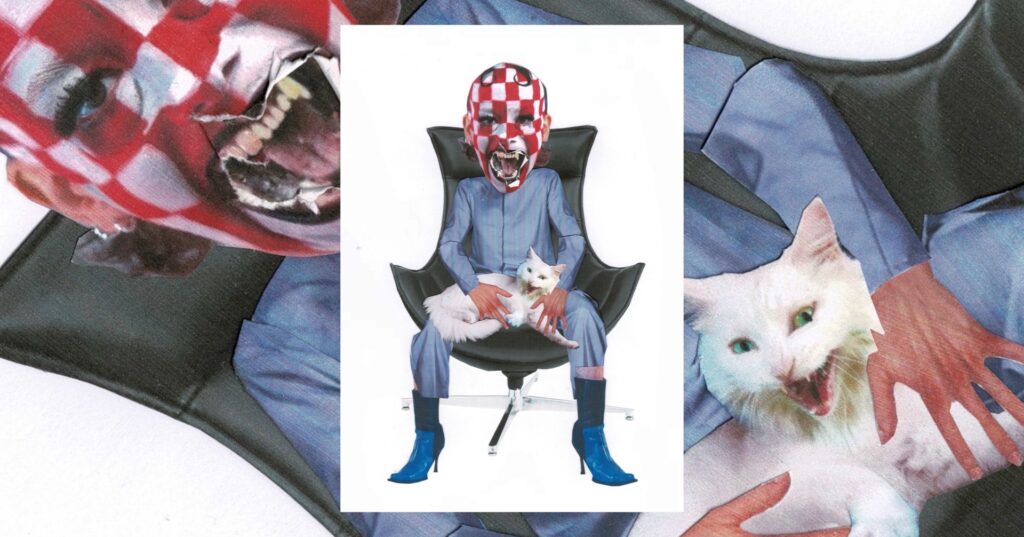
Artwork by Josh Quinton
D Mortimer 2025
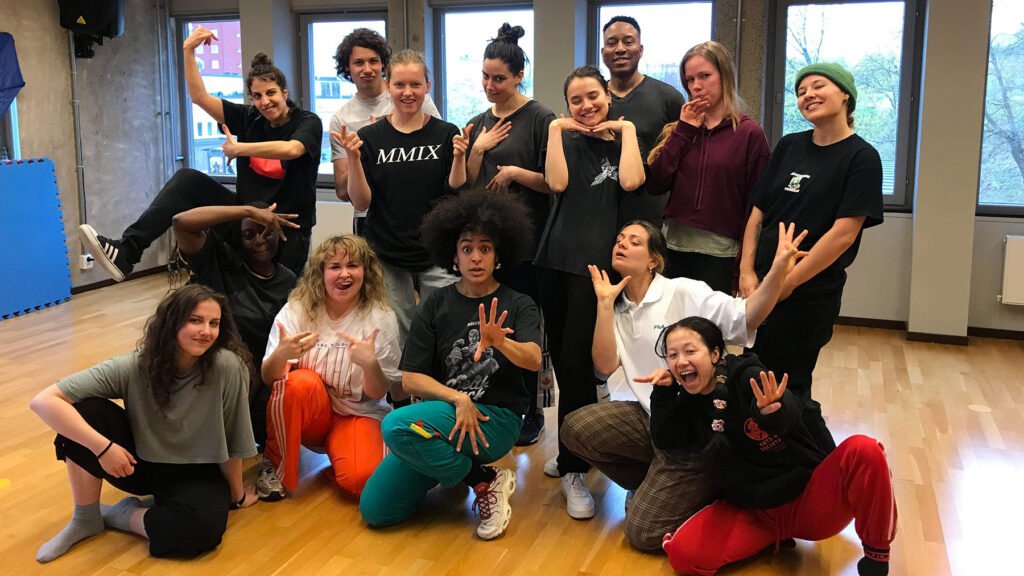
Don’t miss Testo by Wet Mess at Dansens Hus on 12 and 13 May, and a lip syncing workshop at MDT at 11 May.